CALL TODAY
(07) 3741 2825

Understanding Protein: What It Does & How to Meet Your Needs

Blog written by Janice Law

Protein has become one of the most talked-about nutrients in recent years, appearing everywhere from social media trends to supermarket shelves. Over the past few years, high-protein yoghurts, protein bars, and products labelled as ‘extra protein’ have increasingly filled stores, often used as a marketing tool. 

The newly released 2025–2030 US Dietary Guidelines¹ also reflect a broader shift in nutrition priorities. It flipped the traditional food pyramid upside down, shifting the focus from starchy carbohydrates to whole foods, protein and healthy fats.

Beyond the hype and marketing, protein plays a vital role in helping the body function properly for everyone, not just those who exercise. In this blog, we will explore what protein actually does, why it matters for overall health, food sources of protein, and some high-protein snack options to quickly boost your intake.

What Does Protein Do in the Body & Why is it Important?

Generally speaking, protein plays a key role in ² ³

1. Muscle maintenance and repair

2. Immune health

3. Digestion and breaking down food

4. Satiety

5. Supporting metabolism and energy production

Protein is often called the ‘building block’ of the body, because it is made up of smaller units called amino acids. When we eat protein, it is broken down into amino acids, which are then used to support many of our body’s structures and functions, including muscles, skin, hair, nails, and organs.

One example is collagen⁴, a protein that helps support the structure of our connective tissue, skin, and bones. Another example is keratin, which is found in our fingernails and hair.  

One of the most important functions of protein is maintaining and repairing muscle. The amino acids help repair tiny muscle tears and build new muscle tissue after daily activity, exercise, or injury. Over time, it also help reduce age-related muscle loss⁵, supporting mobility and strength as we get older. 

Protein is also essential for recovery from illness. Amino acids are the key components in building antibodies⁶ and immune cells that help the body fight infection.

Beyond rebuilding structure and repair, protein helps form many different enzymes and hormones, which are important for key processes including digestion, metabolism, and energy production (3):

  • Digesting and breaking down protein, fat, and carbohydrate so they can be absorbed efficiently.
  • Carrying nutrients, oxygen and minerals throughout the body.
  • Satiety: Since proteins have a complex structure, it takes longer to digest in the stomach, which helps slow down digestion and keeps us satiated for longer.
  • Supporting the chemical reactions that convert food into energy and keep the body functioning normally.


How Much Protein Should We Eat?

For healthy adults (not severely ill or injured), protein requirements are around 0.8 – 1.0 g per kilogram of body weight per day⁷

For individuals who are more physically active, aiming to build or maintain muscle mass, or working towards weight management goals, a higher protein requirement is often recommended, around 1.2 – 1.5 g per kilogram of body weight per day.

Food Sources

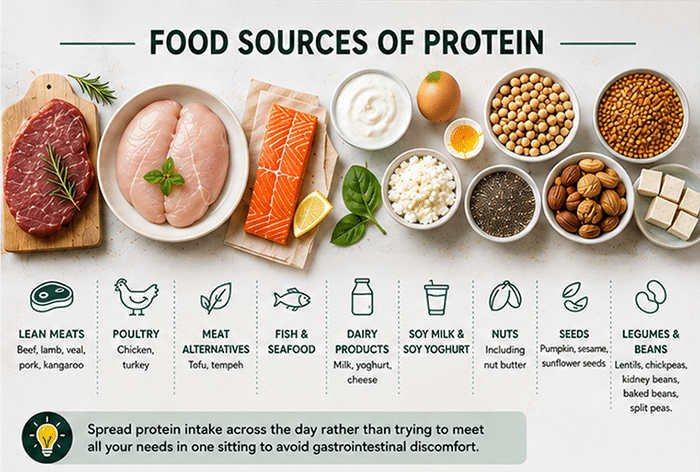
Protein can be found in both animal and plant-based foods (2, 8):

1. Lean meats – beef, lamb, veal, pork, kangaroo

2. Poultry – chicken, turkey

3. Meat alternatives, including tofu and tempeh

4. Fish and seafood

5. Dairy products – milk, yoghurt, cheese

6. Soy milk & soy yoghurt

7. Nuts (including nut butter)

8. Seeds – pumpkin seeds, sesame seeds, sunflower seeds

9. Legumes and beans – lentils, chickpeas, kidney beans, baked beans, split peas

The best approach is to spread protein intake across the day, rather than trying to meet all your needs in one sitting, to avoid gastrointestinal discomfort.

Easy High – Protein Snack Idea

Beyond main meals, snacks can be a simple and convenient way to boost protein intake. This is helpful for people with a higher protein requirement, those who has a busy schedule, or those trying to build muscle mass!

In general, anything over 10g of protein is considered a good option.

Quick and convenient snack ideas:

I. High-protein yoghurt

II. Protein bars

III. 2 Boiled eggs

IV. Crackers with canned tuna or cheese

V. Carrots with hummus

VI. Nut butter on toast

Key Takeaway

As you can see, protein plays such an important role in keeping our bodies functioning properly. There is a reason why protein has become one of the most talked-about nutrients in recent years. Its benefits go far beyond muscle building and exercise!

While protein needs vary from person to person, including a good source of protein at every meal can be a simple yet powerful step towards better health.

If you are seeking more personalised dietary advice tailored to your endometriosis management, I am here to guide you. Book a consultation with me today and take charge of your health using the power of food!

Disclaimer: This information is NOT medical advice and is for informational purposes only. It is not intended to replace personalised medical or dietetic advice.


Reference

1. U.S. Department of Health and Human Services & U.S. Department of Agriculture. (2025). Dietary Guidelines for Americans 2025–2030. https://cdn.realfood.gov/DGA.pdf

2. Better Health Channel (Victoria State Government). Protein. https://www.betterhealth.vic.gov.au/health/healthyliving/protein 

3. The University of Queensland. Protein function and metabolism. 

4. StatPearls Publishing. (2024). Biochemistry, Protein Function. https://www.ncbi.nlm.nih.gov/books/NBK507709/ 

5. Phillips, S. M., & Van Loon, L. J. C. (2016). Dietary protein for athletes. https://pmc.ncbi.nlm.nih.gov/articles/PMC4939566/ 

6. Cleveland Clinic. Antibodies: Function and role in immunity. https://my.clevelandclinic.org/health/body/22971-antibodies 

7. Queensland Health. Estimated energy and protein requirements. https://www.health.qld.gov.au/__data/assets/pdf_file/0022/144175/est-req.pdf

8. Queensland Health. Plant-based eating and nutrition considerations. https://www.health.qld.gov.au/__data/assets/pdf_file/0035/1309958/cf-hphe-plant-based.pdf